New AI security platform promises businesses greater visibility into unauthorized AI tools, employee prompts, and autonomous agents.
Artificial intelligence is rapidly becoming embedded in everyday workplace activities, but the speed of adoption is creating an increasingly difficult challenge for corporate cybersecurity teams: understanding exactly which AI tools employees are using, what information they’re sharing, and where sensitive company data might be going.
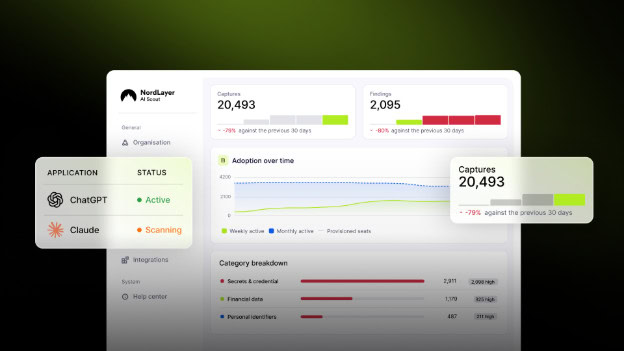
As organizations grapple with this growing problem of “shadow AI,” cybersecurity provider NordLayer has introduced NordLayer AI Scout, a new security and monitoring platform designed to provide visibility into AI applications, employee interactions, and autonomous agents operating across enterprise environments.
The solution combines AI usage monitoring, data loss prevention (DLP), and agent discovery capabilities, promising organizations a clearer picture of their AI exposure without necessarily restricting employees’ access to emerging technologies.
The growing security risks of shadow AI
The rapid proliferation of generative AI tools has fundamentally changed how employees approach everyday tasks, from writing and research to software development and data analysis.
However, much of this activity takes place outside officially sanctioned corporate systems.
Research from the University of Melbourne, cited by NordLayer, suggests that 70% of employees use freely available large language models (LLMs) at work, compared with just 42% using company-provided tools.
This creates a significant visibility gap for IT and security teams, which may have little insight into the information employees are sharing with external AI services.
The financial consequences can also be substantial.
According to IBM figures cited in NordLayer’s announcement, data breaches involving shadow AI carry an additional average cost of approximately $400,000, on top of a global average breach cost of $4.99 million.
Meanwhile, Writer’s 2026 AI Adoption in the Enterprise survey indicates that 59% of companies are investing more than $1 million annually in AI technology.
Together, these figures highlight an emerging challenge: organizations are investing heavily in AI capabilities while potentially overlooking the security implications of tools operating beyond established governance frameworks.
Making AI activity visible across the enterprise
NordLayer AI Scout aims to address this problem by bringing AI interactions into a centralized monitoring environment.
Rather than relying exclusively on traditional application inventories or network restrictions, the platform is designed to observe AI activity across web browsers and desktop environments.
According to NordLayer, the solution can identify both authorized and unauthorized AI applications, providing security administrators with information about which tools employees are using and how frequently they interact with them.
The platform also incorporates monitoring of AI prompts, enabling organizations to identify potentially sensitive information before it is submitted to external services.
This approach reflects a broader shift in enterprise cybersecurity, where understanding how AI systems interact with corporate information is becoming as important as controlling access to the applications themselves.
“What companies are facing today is an AI zoo — dozens of unsanctioned LLMs in daily use across the workforce, each one widening the organization’s exposure to data leaks and security breaches,” says Andrius Buinovskis, VP of Product Strategy at NordLayer.
“True AI governance requires extensive visibility. With new LLM solutions emerging at a rapid pace, reviewing every new AI tool manually simply doesn’t scale.”
Moving data protection directly into AI interactions
One of the distinguishing features of NordLayer AI Scout is its approach to data loss prevention.
Traditional DLP technologies have generally focused on monitoring files, emails, and network transfers to prevent confidential information from leaving an organization.
However, generative AI introduces another potential route for sensitive data exposure: employees entering confidential information directly into AI prompts.
NordLayer’s solution extends DLP controls to these interactions, with the ability to warn users, redact sensitive information, or block prompts before they are submitted.
The company says this functionality operates across supported browser-based AI tools and is designed to reduce the risk of confidential business information being inadvertently shared with external AI providers.
“We built NordLayer AI Scout for how AI actually works — not just what it looks like from the outside, but for what’s happening at a technical level,” explains Vakaris Noreika, VP of Product Research and Development at NordLayer.
“Its AI DLP is designed to inspect prompts and control them pre-submission, to ensure that sensitive data is never inputted in the first place.”
The distinction is important because preventing sensitive information from entering an external AI system may be considerably more effective than attempting to manage its exposure afterward.
Nevertheless, the effectiveness of such protections will depend on factors including application compatibility, policy configuration, and the accuracy of sensitive-data detection.
Extending security oversight to autonomous AI agents
Beyond conventional generative AI applications, NordLayer AI Scout also addresses another emerging cybersecurity challenge: autonomous AI agents.
As businesses increasingly experiment with agentic AI systems capable of interacting with applications, retrieving information, and performing tasks independently, security teams face new questions about what those agents can access and execute.
NordLayer’s platform includes visibility into Model Context Protocol (MCP) servers, which allow AI applications and agents to connect with external tools and data sources.
The system is designed to identify agent connections, available resources, and the capabilities exposed through those connections.
This includes an inventory of the skills and tools available to AI agents, potentially helping administrators identify excessive permissions or unexpected access to sensitive business systems.
Such capabilities could become increasingly relevant as enterprises move beyond AI chatbots toward more autonomous workflows.
An AI assistant summarizing a document presents a different risk profile from an autonomous agent capable of accessing corporate databases, modifying records, or executing actions across connected services.
Understanding those distinctions will be essential for organizations attempting to establish effective AI governance policies.
Measuring real AI adoption rather than purchased licenses
Another aspect of NordLayer AI Scout focuses on the business value of AI investments.
While organizations frequently measure AI adoption through purchased licenses or approved applications, these figures may provide an incomplete picture of actual usage.
NordLayer’s platform instead measures observed activity across AI tools, including applications operating outside officially sanctioned environments.
Its analytics capabilities are designed to distinguish active users from paid or provisioned seats, identify adoption patterns, and estimate token expenditure across deployed LLMs.
This information could help businesses identify underutilized subscriptions, understand which tools employees genuinely prefer, and determine where additional investment or training may be warranted.
It could also reveal situations where employees consistently turn to unauthorized AI services because approved alternatives fail to meet their needs.
Rather than treating every instance of shadow AI as a compliance violation, organizations could potentially use these insights to improve their technology strategies.
Balancing AI security with employee privacy
Although greater visibility into AI activity offers clear security benefits, it also raises important questions about employee monitoring and data privacy.
Tools capable of inspecting prompts and tracking AI usage must be implemented with appropriate safeguards, particularly where interactions could contain personal information or confidential communications.
Organizations adopting this type of technology will need to establish clear policies governing what information is collected, who can access it, how long it is retained, and how monitoring practices are communicated to employees.
Security teams must also consider the potential for false positives, particularly when automated systems attempt to distinguish sensitive information from legitimate business activity.
The challenge is therefore not simply to make AI usage visible, but to ensure that increased oversight remains proportionate, transparent, and consistent with applicable privacy requirements.
Bringing AI governance into everyday operations
NordLayer AI Scout is now available to organizations seeking greater oversight of their AI environments.
The launch reflects an increasingly important development in enterprise cybersecurity: the transition from managing individual AI applications toward understanding the wider ecosystem of tools, agents, data connections, and employee interactions.
As AI becomes more deeply integrated into business operations, traditional approaches based primarily on application approval and access restrictions may prove insufficient.
Platforms offering more granular visibility could help organizations manage security risks while allowing employees to benefit from emerging AI capabilities.
However, the ultimate effectiveness of these solutions will depend not only on their technical capabilities but also on how thoughtfully businesses implement governance, privacy protections, and employee education.
For organizations navigating the increasingly complex world of enterprise AI, the central challenge may no longer be deciding whether employees should use artificial intelligence, but understanding how they are already using it.