
Pre-Recycling Technology reduces waste and improves efficiency
At SXSW in Austin, Texas, a small machine was quietly crushing plastic bags into dense blocks. The demonstration wasn’t a recycling machine in the traditional sense — it was something different. It was a “pre-recycling” system designed to solve one of recycling’s biggest problems before the material even reaches a recycling facility.
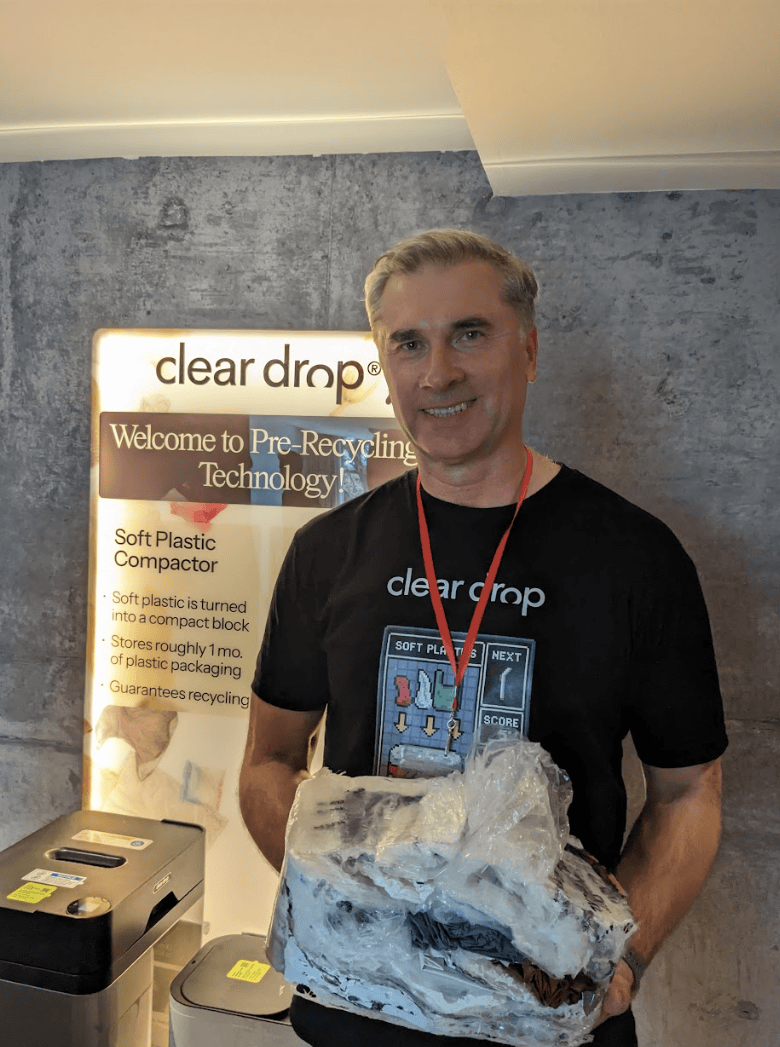
Ivan Abrouzon, President, Founder and CEO of Clear Drop, Inc., demonstrated the company’s technology during SXSW events in Austin. The Clear Drop system compresses soft plastic — commonly known in the industry as plastic film — into dense blocks that are easier to transport and process for recycling.
Soft plastic is one of the most difficult materials to recycle. Plastic bags and film packaging often clog recycling machinery and are inefficient to transport because they consist mostly of air. As a result, much of this material ends up in landfills or as roadside waste.
Clear Drop’s approach is what Abrouzon calls “pre-recycling” — creating appliances that serve as collection and compression points before materials reach recycling facilities.
Instead of transporting loose bags of plastic film, the Clear Drop machine compresses the material into Soft Plastic Blocks (SPB) weighing roughly four to five pounds. These compressed blocks can be transported more efficiently and fed directly into recycling grinders without causing the clogging issues that loose plastic film often creates.
The system also uses a special plastic envelope that is recycled together with the compressed material when it is transported to partner recycling facilities.
A Missing Link In The Recycling Chain
Abrouzon describes Clear Drop as filling a gap in the recycling process — the space between when plastic is discarded and when it reaches recycling facilities.
“There’s a kind of big hole in between that sucks in the majority of the material before they even get it to the recycling plant,” he explains. The goal of Clear Drop is to shorten the distance between disposal and recycling and make it easier for people and organizations to recycle soft plastics.
Clear Drop currently operates with two business streams:
- Consumer systems for households
- Commercial systems for businesses and institutions
Hospitals are a particularly interesting use case because large amounts of clean polyethylene packaging are used in medical environments. This plastic is high quality and well suited for recycling if it can be properly collected and transported.
Beyond Plastic: Organic Waste Systems
Clear Drop is also developing systems for organic waste collection and storage. These systems allow organic waste to be stored without odor for extended periods and then transferred to composting systems or organic recycling facilities.
By separating organic waste and soft plastics from general waste streams, Abrouzon believes recycling efficiency can be significantly improved. Removing these materials from the general waste stream leaves paper, metal, glass, and hard plastics — materials that are much easier to recycle effectively.
Clear Drop’s broader vision is to develop technologies that address multiple waste and disposal challenges, helping reduce landfill waste and improve recycling outcomes through better collection and material handling systems.