New robotic technology enables surgeons to reconstruct stomach tissue entirely through the mouth, potentially transforming minimally invasive gastrointestinal surgery.
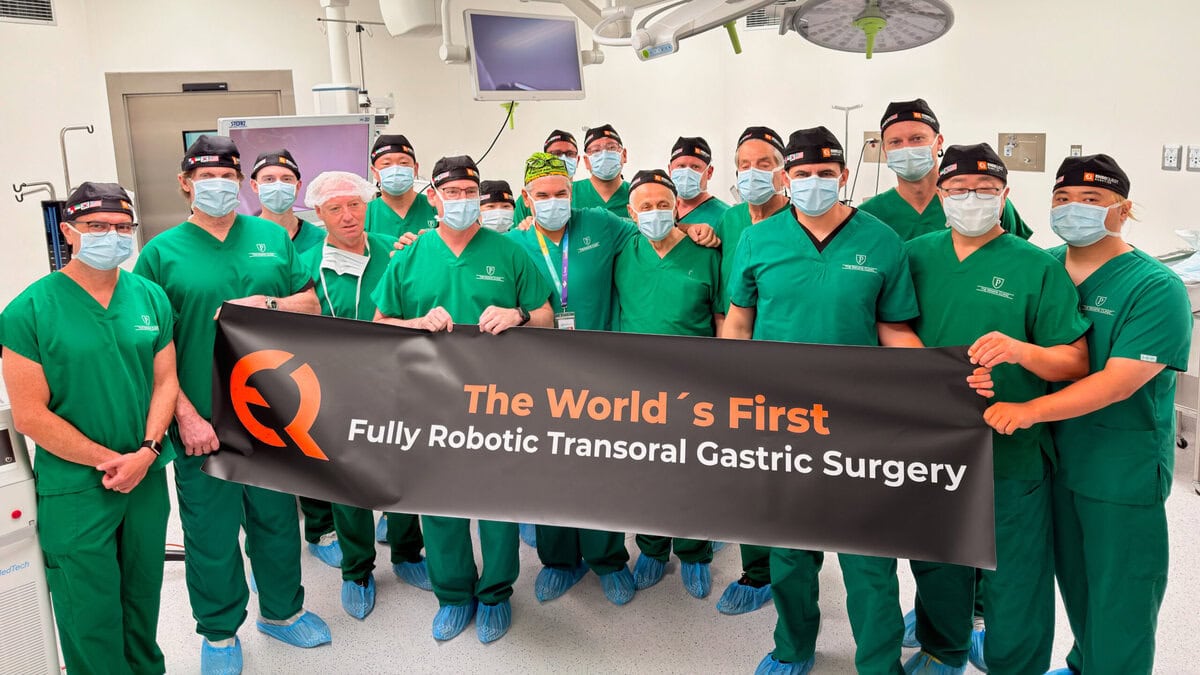
Medical robotics has reached another milestone, with EndoQuest Robotics announcing the successful completion of two fully robotic gastric reconstruction procedures performed entirely through patients’ mouths, eliminating the need for external surgical incisions.
The procedures, conducted at The Panama Clinic in Panama City, represent what the company describes as the world’s first fully robotic transoral gastric reconstructions and the first clinical application of its Endoluminal Surgical (ELS) System in the upper gastrointestinal tract.
The achievement could mark an important step toward a new generation of minimally invasive surgical procedures, allowing physicians to perform complex tissue reconstruction inside the body using flexible robotic instruments.
Bringing Robotic Surgery Inside the Stomach
Traditional robotic surgery generally requires small incisions through which surgical instruments and cameras are introduced into the body.
EndoQuest’s approach takes a different route.
Its Endoluminal Surgical System uses flexible robotic technology designed to navigate the body’s natural openings, allowing surgeons to perform procedures without making external incisions.
In the recently completed procedures, surgeons introduced robotic instruments through the mouth and into the stomach, where they were able to manipulate and reconstruct tissue from within.
Crucially, the system allows physicians to independently control two robotic instruments, providing greater dexterity and precision than conventional flexible endoscopic tools.
This two-handed robotic capability is particularly important for complex procedures involving suturing, tissue manipulation, and reconstruction.
The technology is designed to enable surgeons to work within deeper layers of stomach tissue, apply controlled tension, and perform full-thickness suturing.
These capabilities could help address some of the technical limitations associated with traditional endoscopic surgery.
The development also reflects the wider evolution of robotics beyond conventional industrial applications. As explored in our recent article on bringing AI into the physical world with robotics and autonomous systems, increasingly sophisticated machines are expanding the possibilities for precision and automation across multiple industries.
While EndoQuest’s system is surgeon-controlled rather than an autonomous AI platform, both developments illustrate how advanced robotics is enabling increasingly complex physical tasks.
Addressing Complications Following Gastric Bypass Surgery
The initial procedures focused on gastric reconstruction techniques intended to address complications that can develop following gastric bypass surgery.
Although gastric bypass is an established treatment for obesity, some patients subsequently experience weight regain or a condition known as refractory dumping syndrome.
Dumping syndrome occurs when food moves too rapidly from the stomach into the small intestine, potentially causing nausea, abdominal pain, diarrhea, and other uncomfortable symptoms.
One contributing factor can be enlargement of the opening between the stomach pouch and the small intestine.
An established treatment called transoral outlet reduction (TORe) addresses this problem by using an endoscope and suturing instruments to reduce the size of that opening.
However, conventional endoscopic systems can limit the surgeon’s ability to manipulate multiple instruments independently.
EndoQuest’s robotic platform builds on this established approach, potentially giving physicians greater control when placing sutures and reconstructing stomach tissue.
The company hopes that improved precision and deeper tissue suturing could eventually lead to more consistent and durable outcomes.
However, these potential advantages will require further clinical evaluation.
A New Frontier for Flexible Robotic Surgery
The procedures were performed at The Panama Clinic under the leadership of Dr. Todd Wilson and local principal investigator Dr. Richard Altieri Pérez.
Dr. Wilson serves as EndoQuest Robotics’ Chief Medical Officer and Chairman of its International Advisory Board. He is also Professor of Surgery at McGovern Medical School at UTHealth Houston.
“These cases demonstrate a fundamentally new robotic endoluminal gastric reconstruction,” said Dr. Wilson.
“We can bring basic surgical technique directly to the target, without external incisions. This opens up vast opportunities to conduct direct, durable interventions that aren’t practical or even possible today.”
The procedures also represent an important development in the broader field of natural-orifice surgery.
Researchers have explored surgical techniques using the body’s natural openings for decades, but limitations in instrument control, dexterity, and tissue manipulation have restricted their applications.
Flexible robotic platforms could help overcome some of these barriers.
The use of advanced technology to expand surgical capabilities is not entirely new. Tech Trends previously examined how augmented reality could help train the next generation of surgeons, allowing specialists to collaborate remotely and improve access to surgical expertise.
Similarly, our earlier coverage of virtual reality and medicine explored how immersive technologies and mixed reality could help surgeons visualize complex anatomy and develop critical skills.
EndoQuest’s innovation represents another dimension of this technological evolution, bringing enhanced physical control directly into the surgical procedure itself.
Dr. Santiago Horgan, Professor Emeritus of Surgery at the University of California, San Diego School of Medicine, highlighted the significance of this technological evolution.
“The vision of performing surgery without external incisions was compelling, but the technology was not yet ready,” he said.
“Flexible robotics now offers a way to overcome those longstanding limitations, close the gap between endoscopy and surgery, and ultimately improve outcomes for patients.”
Expanding the Possibilities of Robotic Gastrointestinal Surgery
The gastric reconstruction procedures form part of EndoQuest’s broader efforts to develop robotic technologies for gastrointestinal interventions.
The company is also investigating robotic transoral gastric plication, an experimental procedure intended to reduce stomach capacity without external incisions.
The technique uses sutures placed from outside the stomach to reduce its capacity, while the surgical instruments access the treatment area through the mouth.
In a preclinical study conducted at Brigham and Women’s Hospital, the technique achieved a mean gastric volume reduction of 70%.
Although encouraging, these findings come from preclinical research and do not establish equivalent results in human patients.
The company has also been evaluating its ELS System for procedures involving the lower gastrointestinal tract.
In July 2026, EndoQuest completed enrollment in its PARADIGM Trial, a US multicenter clinical study investigating the robotic system’s ability to remove abnormal tissue from the lower digestive tract.
According to the company, its platform has now been evaluated in nearly 100 clinical cases worldwide, including 50 colorectal endoscopic submucosal dissection procedures in the PARADIGM Trial.
Together, these developments suggest that flexible robotic technology could eventually support a wider range of gastrointestinal interventions.
FDA Recognition and Plans for a 2027 US Launch
EndoQuest’s ELS System has been accepted into the US Food and Drug Administration’s Safer Technologies Program (STeP).
The program is designed to support the development and review of medical devices that may significantly improve the safety of currently available treatments.
Acceptance into the program does not constitute FDA clearance or approval, but it provides a framework for additional interaction with regulators during development.
EndoQuest is preparing a De Novo Classification Request and is targeting a US commercial launch in 2027, subject to receiving FDA marketing authorization.
The company says its ELS System is currently the only surgical robotic platform under active development to have been accepted into the program.
“These procedures expand the ELS System beyond the lower GI application evaluated in PARADIGM and mark the beginning of a new phase for EndoQuest,” said Eduardo Fonseca, Chief Executive Officer of EndoQuest Robotics.
Fonseca added that the company sees opportunities to expand its platform into upper gastrointestinal and endobariatric procedures.
The ELS System remains an investigational medical device and has not been cleared by the FDA for commercial use in the United States.
Could Incision-Free Robotic Surgery Become the Future?
The emergence of flexible robotic surgical systems reflects a broader shift in medical technology toward less invasive procedures.
Conventional robotic surgery has already expanded the capabilities of surgeons by improving instrument precision, visualization, and control.
However, many robotic systems still rely on surgical incisions to access internal organs.
Natural-orifice robotic platforms could potentially extend these capabilities to procedures performed entirely within the gastrointestinal tract.
For patients, the longer-term possibilities include avoiding external surgical wounds and potentially reducing some complications associated with invasive procedures.
For surgeons, improved instrument control could make technically demanding endoscopic procedures more accessible.
This transformation is part of a broader wave of healthcare innovation, in which digital technologies are increasingly changing how medical professionals diagnose, treat, and monitor patients.
For example, Tech Trends recently explored how AI-assisted prenatal ultrasound technology is helping clinicians incorporate advanced computational tools into routine medical imaging.
Although the technologies serve very different purposes, both illustrate how sophisticated systems are moving from research environments into clinical applications.
Nevertheless, important questions remain about clinical outcomes, procedural durability, training requirements, costs, and how these systems compare with existing treatments.
The successful completion of two robotic transoral gastric reconstruction procedures represents an early clinical milestone rather than definitive evidence of superiority over conventional techniques.
Further studies will be needed to establish the safety, effectiveness, and long-term benefits of this approach.
Still, EndoQuest’s achievement illustrates how robotics could continue to blur the boundaries between traditional surgery and endoscopy.
As flexible robotic technologies advance, procedures that once required external incisions may increasingly become possible through the body’s natural openings.