As children grow up surrounded by digital entertainment, two new activity books from Highlights offer a timely reminder of the appeal of hands-on creativity and problem-solving.
In an age when almost every form of entertainment seems to involve a screen, there’s something refreshingly appealing about a book that encourages children to put down their devices and start doing something.
Not simply reading, but making, experimenting, exploring, solving puzzles and discovering new interests.
Technology has undoubtedly transformed childhood, bringing extraordinary opportunities for learning, creativity and connection. Yet alongside the growing sophistication of digital entertainment, there’s also an interesting countertrend emerging: a renewed appreciation for physical experiences that don’t require an app, an internet connection or a rechargeable battery.
It’s a theme that feels particularly relevant as Highlights celebrates its 80th anniversary with two activity books designed to keep young minds engaged away from screens.
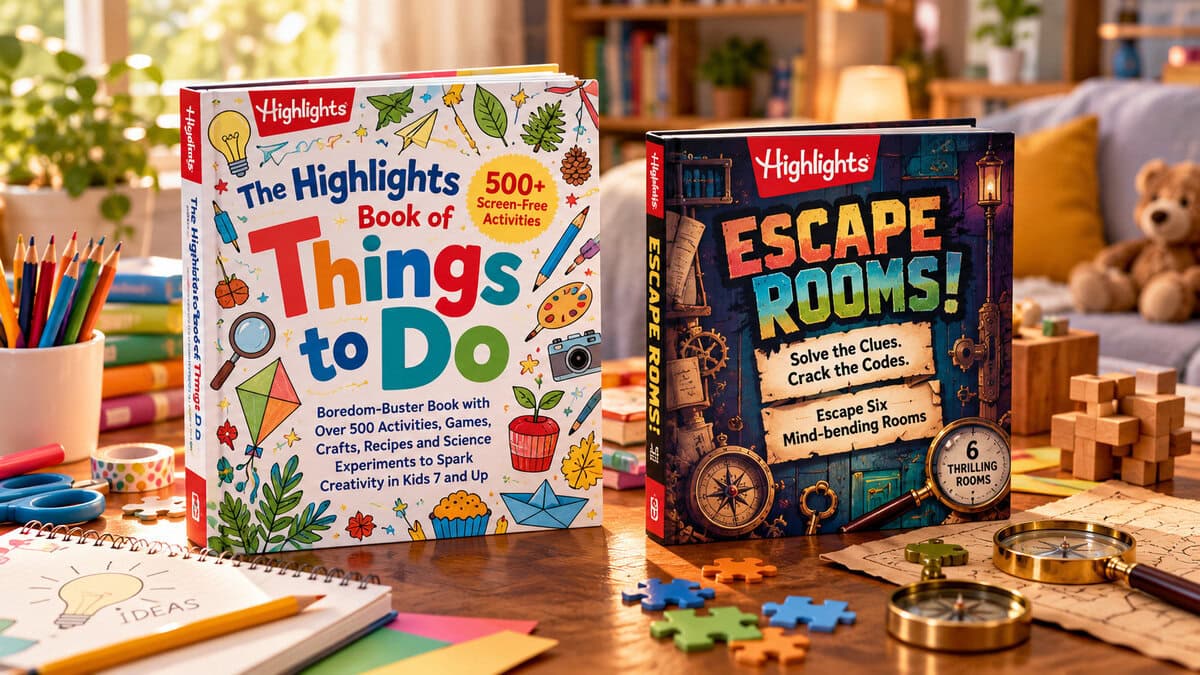
The Highlights Book of Things to Do and Escape Rooms! Solve the Clues. Crack the Codes. Escape Six Mind-bending Rooms approach the challenge differently, but share a common philosophy: children don’t necessarily need more entertainment delivered to them. Sometimes, they simply need something interesting to do.
Finding creativity beyond the screen
The first book, The Highlights Book of Things to Do, takes a broad approach to screen-free entertainment.
Originally published in hardcover in 2020 and now available in a more affordable paperback edition, the 372-page collection features more than 500 activities aimed at children aged seven and older.
The range is deliberately eclectic.
Children can experiment with making rock candy, learn magic tricks, create comic strips, build box kites, explore nature or put together time capsules.
Other activities introduce cooking, crafts, science experiments, puzzles and outdoor adventures.
The variety is one of the book’s most appealing qualities.
Rather than prescribing a particular interest, it offers opportunities for children to discover what captures their imagination.
A child fascinated by science might gravitate towards experiments, while another might prefer drawing, building things or trying a new recipe.
Importantly, many of these activities also encourage children to develop practical skills through experimentation.
And unlike digital entertainment, where the experience is often carefully designed and controlled, hands-on activities introduce an element of unpredictability.
Things don’t always work the first time.
A homemade experiment might produce an unexpected result. A craft project might require improvisation. A new skill might take several attempts to master.
That process of trying, adapting and trying again is an important part of learning.
Bringing the escape-room experience to paper
The second title, Escape Rooms!, takes a more focused approach.
Designed for children aged eight to twelve, the 56-page hardcover book contains six illustrated escape-room challenges.
Each scenario invites readers to investigate their surroundings, identify clues, crack codes and solve interconnected puzzles.
The premise will be familiar to anyone who has experienced a physical escape room or played a digital puzzle adventure.
But here, the entire experience unfolds on paper.
Instead of tapping objects on a screen or navigating a virtual environment, children must examine illustrations, make connections and work through the challenges themselves.
The format is particularly interesting because it borrows the structure of interactive entertainment without requiring the technology normally associated with it.
Each room presents a different environment and collection of mysteries, with puzzles designed to reward careful observation and logical thinking.
Some challenges can be approached quickly, while others require patience and more sustained attention.
The book can also provide opportunities for collaborative problem-solving, with children working through clues together rather than tackling every puzzle independently.
For families looking for alternatives to digital games, this is an appealing concept.
It retains the sense of discovery, progression and achievement that makes interactive entertainment engaging, but translates those qualities into a physical experience.
Screen-free doesn’t have to mean anti-technology
Perhaps the most interesting aspect of these books is what they suggest about the broader conversation surrounding children’s screen time.
It’s tempting to frame the issue as a competition between traditional activities and modern technology.
But that distinction is increasingly unhelpful.
Digital experiences can be educational, creative and socially engaging. Equally, not every activity involving a physical object necessarily encourages meaningful learning.
The more useful question is whether children are actively participating in an experience or simply consuming entertainment.
This is something we’ve explored recently at Tech Trends in our coverage of helping children become technology creators.
That article examined how coding, robotics and hands-on STEM education can encourage children to move beyond passive consumption towards building, experimenting and solving problems.
Interestingly, many of the same principles apply to traditional activity books.
Whether children are programming a robot, building a model, solving a logic puzzle or conducting a science experiment, the underlying skills often overlap.
Curiosity, creativity, persistence and problem-solving aren’t inherently digital or analogue.
They’re human skills that can be developed through many different experiences.
The enduring appeal of physical experiences
There are also qualities that physical books and activities offer which digital experiences don’t always replicate.
A book doesn’t send notifications.
It doesn’t require an account, encourage in-app purchases or compete for attention with an endless stream of recommended content.
Children can return to an unfinished puzzle, revisit a favourite activity or work at their own pace without an algorithm deciding what should come next.
Physical activities also create opportunities for shared experiences.
Making something together, working through a difficult puzzle or attempting a science experiment can encourage conversations and collaboration that extend beyond the activity itself.
This isn’t necessarily an argument against digital learning.
Indeed, as Tech Trends explored in our earlier coverage of virtual reality in education, immersive technology can offer extraordinary educational opportunities when used thoughtfully.
The point is that different experiences offer different benefits.
A virtual field trip can introduce children to places they might never otherwise visit.
A physical activity book can encourage them to explore their own surroundings, make something with their hands or discover an interest they hadn’t previously considered.
There’s room for both.
Eighty years of encouraging curiosity
The timing of these releases is particularly appropriate.
Highlights Magazine is celebrating its 80th anniversary in 2026, marking eight decades of encouraging children to explore, question and engage with the world around them.
Although the brand now operates across digital platforms as well as traditional publishing, its activity books reflect a philosophy that has remained remarkably consistent.
Highlights CEO Kent Johnson recently described the renewed interest in offline experiences as a rebalancing away from screens.
It’s a useful way of thinking about the trend.
Rather than abandoning technology, families may increasingly be looking for a healthier balance between digital entertainment and other forms of play.
And there’s something reassuring about the fact that activities which entertained previous generations can still appeal to children growing up in a very different technological environment.
Two different approaches to screen-free engagement
For parents considering the two books, the choice largely depends on the child’s interests.
The Highlights Book of Things to Do is the more versatile option, offering hundreds of activities across a wide range of subjects.
It’s particularly well suited to children who enjoy exploring different interests, making things and discovering new projects.
Escape Rooms!, meanwhile, offers a more structured experience.
Its illustrated challenges are aimed at children who enjoy mysteries, codes and logic puzzles, particularly those motivated by the satisfaction of solving a difficult problem.
Both books are designed to encourage active participation, although they do so in distinctly different ways.
The Highlights Book of Things to Do
- Ages: 7+
- Format: Paperback, 372 pages
- Publication date: September 29, 2026
- Price: $19.99
- ISBN: 9781639626489
Escape Rooms! Solve the Clues. Crack the Codes. Escape Six Mind-bending Rooms
- Ages: 8–12
- Format: Hardcover, 56 pages
- Publication date: October 13, 2026
- Price: $16.99
- ISBN: 9781639625185
Finding balance in a digital childhood
As technology becomes more deeply integrated into children’s lives, it’s worth remembering that innovation doesn’t always mean replacing what came before.
Sometimes it means recognising the continuing value of experiences that have been around for generations.
The appeal of these two Highlights books isn’t that they offer an escape from technology altogether.
It’s that they provide opportunities for children to engage with the world in different ways.
Whether they’re building something, experimenting with a new idea or working through a complicated puzzle, the emphasis is on participation rather than passive consumption.
And in a world where entertainment is increasingly available at the swipe of a finger, encouraging children to slow down, explore and create might be one of the most valuable things we can offer them.
Review copies of both books were provided to Tech Trends by Highlights Press.