Step inside a virtual world that responds to your body’s stress levels in real time.
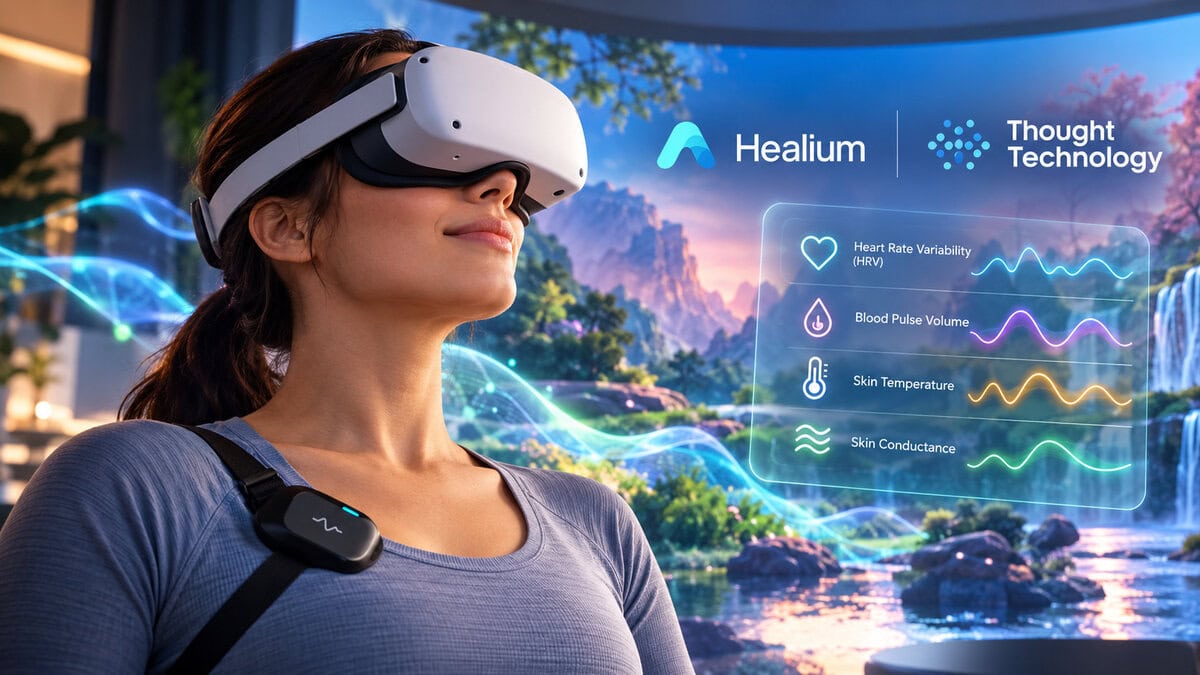
That’s the idea behind a new integration from Healium, which has partnered with Thought Technology to bring more sophisticated biometric monitoring into immersive virtual reality experiences.
Announced on October 6, 2026, the partnership integrates Thought Technology’s eVu-TPS physiological sensor with Healium’s VR platform, allowing users to experience changes in their biometric data through responsive virtual environments.
Rather than simply displaying information on a smartwatch or dashboard, the technology aims to make physiological signals something users can actually see and experience.
Making biometric data immersive
Most wearable technology presents health information through numbers, graphs, and notifications. Healium takes a different approach.
Its platform uses virtual, mixed, and augmented reality to create environments that respond to physiological changes.
The new eVu-TPS integration expands the system’s capabilities by introducing four biometric measurements:
- Heart rate variability (HRV): Changes in the intervals between heartbeats.
- Blood pulse volume: Information about changes in blood flow.
- Skin conductance: Changes in the skin’s electrical conductivity, often associated with physiological arousal.
- Skin temperature: Another indicator that can contribute to understanding physiological responses.
By incorporating these signals into immersive experiences, Healium hopes to make biofeedback more intuitive and engaging.
Sarah Hill, CEO and Chief Storyteller at Healium, describes the approach as giving biometric data another dimension.
Rather than simply observing physiological measurements, users can enter virtual environments influenced by their own bodies.
Bringing VR biofeedback into healthcare
The integration is particularly relevant to behavioral health and pain management practices.
Clinicians can access additional physiological data during immersive sessions, while patients receive visual feedback that may help them better understand and regulate their responses to stress.
Healthcare applications of immersive technology have been developing for years, with earlier research exploring how virtual reality could improve healthcare experiences.
The technology could also have applications beyond clinical settings, including relaxation, performance preparation, and wellness.
Importantly, the system is designed to complement existing approaches to self-regulation rather than replace established medical treatments.
The eVu-TPS-compatible Healium VR package is available immediately to behavioral health and pain practices in the United States.
Beyond traditional wearables
The announcement reflects an interesting evolution in wearable technology.
For years, connected devices have focused on collecting increasingly detailed information about our bodies.
But collecting data is only part of the challenge. Making that information meaningful—and potentially actionable—is another.
Healium’s approach, which the company calls spatialized biometrics, explores how immersive computing could bridge that gap.
By translating physiological signals into responsive virtual experiences, technologies like this could change how people interact with their own health data.
The development also reflects the growing maturity of enterprise XR applications across healthcare and other industries.
Whether immersive biofeedback ultimately delivers measurable improvements over conventional approaches will depend on further clinical evaluation.
Nevertheless, the combination of biometric sensing and extended reality represents a promising direction for digital health innovation.