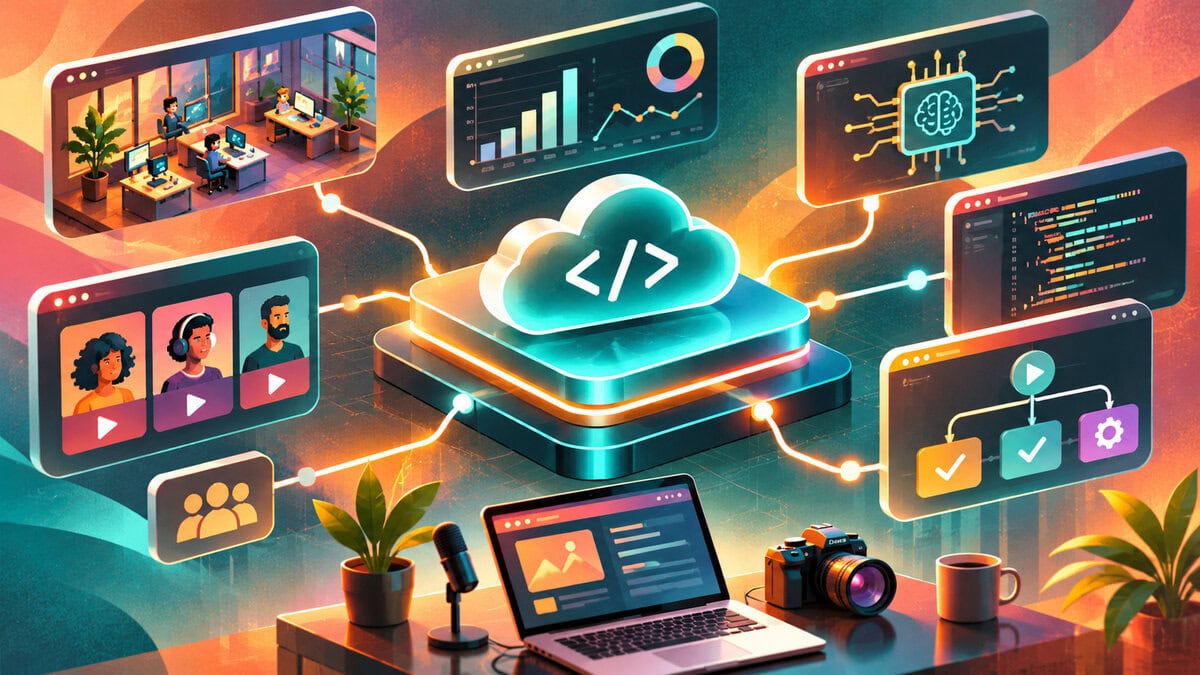
An open approach to creator technology is enabling businesses to develop their own tools, automate operations, and even launch new software products.
The creator economy has evolved far beyond individual influencers and content producers. Today, sophisticated businesses manage large teams, multiple creator accounts, complex communications workflows, and increasingly substantial commercial operations.
Yet much of the technology supporting these businesses remains locked inside proprietary software ecosystems, leaving companies dependent on the features and development priorities of their technology providers.
OnlyMonster, a global Creator Operations (CreatorOps) platform, is challenging that model with an open API that allows customers to build their own software on top of its existing infrastructure.
The company announced on November 16 that approximately 200 creator teams are already developing applications using its API, including virtual offices, AI-powered analytics systems, and independently commercialized software products.
The development raises a broader question extending well beyond the creator economy: Should software companies focus on building every feature their customers might need, or provide the infrastructure that allows those customers to innovate independently?
Breaking Away From Closed Software Ecosystems
For many businesses, adopting a software platform involves accepting certain limitations.
While proprietary systems can provide convenient, integrated functionality, they may also restrict access to operational data, prevent integration with external applications, or make it difficult to develop specialized tools.
These constraints become particularly significant as businesses grow and their operational requirements become more complex.
OnlyMonster’s approach is to provide customers with an accessible, documented API that allows them to create proprietary management systems, connect third-party applications, develop performance dashboards, and automate workflows.
Unlike API programs that require special developer approval or remain in limited beta testing, OnlyMonster says its API is available to customers without additional authorization.
Developers can generate access tokens and begin working with supported account data, messaging functions, and real-time notifications.
Webhooks and data export capabilities provide additional flexibility for integrating external systems.
The approach reflects a wider shift toward modular technology infrastructure, where businesses increasingly expect their software platforms to work together rather than operate as isolated environments.
From Software Customers to Software Developers
Perhaps the most significant aspect of OnlyMonster’s announcement is that customers are not simply building internal tools.
Some are developing products that they can sell to other businesses.
One example is OnlyOffice, developed by creator agency Delmar CO.
Built using OnlyMonster’s API, OnlyOffice is a game-style virtual office where team members appear as avatars. Managers can monitor live activity, employee shifts, and operational alerts through an interactive environment.
Rather than keeping the application exclusively for internal use, Delmar CO is now marketing it as a standalone product.
Another example is ValeoLegacy, an agency-developed management platform that connects operational data to live performance dashboards.
The platform also incorporates an AI-assisted quality analysis tool that reviews subscriber conversations to evaluate communications performance.
According to ValeoLegacy, this particular conversation-analysis capability operates exclusively through its OnlyMonster integration, although the broader management platform supports other software providers.
These examples illustrate how accessible APIs can transform businesses from passive software consumers into active participants in technology development.
They also demonstrate how specialized industry knowledge can translate into commercial software products.
An agency that understands the practical challenges of managing creator operations may be particularly well positioned to develop tools that address problems overlooked by larger technology providers.
A Different Approach to Software Innovation
Pavlo Kharmanskyi, founder of OnlyMonster, believes software providers should enable customers to pursue their own ideas rather than constrain them through predetermined product roadmaps.
“Creator teams are running serious operations now. Why should a software supplier’s roadmap decide how ambitious they can be?”
Kharmanskyi argues that giving developers access to the underlying infrastructure can produce innovations that platform providers might never have anticipated.
“The next big breakthrough in creator technology could come from a five-person agency with a laptop. Give them the tools and see what happens.”
This philosophy has implications for the wider technology industry.
Traditionally, enterprise software companies have competed by expanding their feature sets and encouraging customers to consolidate their operations within proprietary environments.
An API-driven model creates a different competitive dynamic.
Instead of attempting to anticipate every possible customer requirement, software providers can concentrate on delivering reliable infrastructure while encouraging third-party developers to extend its capabilities.
This approach also creates opportunities for smaller businesses to develop specialized products without having to build every underlying component themselves.
As AI-powered business tools become increasingly sophisticated, access to operational data and integration capabilities is becoming an important factor in determining how effectively organizations can deploy automation.
The Role of AI in Creator Operations
Artificial intelligence is another important element of the emerging CreatorOps ecosystem.
Creator businesses increasingly rely on automated workflows, analytics, and communications tools to coordinate operations across multiple platforms.
OnlyMonster already incorporates AI and automation within its operating environment, but its open API allows customers to develop additional capabilities tailored to their own requirements.
ValeoLegacy’s conversation-analysis system demonstrates one potential application.
By combining operational data with AI-assisted analysis, businesses can develop tools that evaluate communications performance and identify opportunities for improvement.
Other possibilities include customized reporting systems, automated operational alerts, and specialized management interfaces.
The broader opportunity lies in allowing businesses to integrate AI into existing workflows rather than forcing them to adopt entirely new operating systems.
This reflects a recurring theme in enterprise technology: the value of AI increasingly depends on how effectively it can access relevant data, interact with existing applications, and support real operational processes.
The challenge of managing and monitoring increasingly autonomous systems is also becoming more important, as highlighted by recent developments in AI agent infrastructure and persistent memory.
Openness Creates New Responsibilities
Allowing third-party developers to build commercial products on a platform’s infrastructure introduces additional technical responsibilities.
When an external business begins selling software that depends on an API, the reliability of that API becomes critical not only to the original platform’s customers but also to the customers of its developer ecosystem.
Radyslav Liaskovskyi, OnlyMonster’s co-founder and Chief Technology Officer, acknowledges this responsibility.
“The moment another business starts selling a product powered by your API, the stakes change. Their customers depend on your infrastructure too.”
Security, reliability, and access controls therefore become fundamental requirements for supporting an expanding developer ecosystem.
The company’s open approach does not eliminate every restriction. OnlyMonster notes that certain advanced API features vary depending on the connected creator platform.
This distinction matters because even open software ecosystems can remain dependent on the technical capabilities and policies of the services with which they integrate.
Nevertheless, the ability to export data, connect external applications, and develop independent tools can provide businesses with greater flexibility than entirely closed systems.
A Growing CreatorOps Ecosystem
Founded in 2023, OnlyMonster says it now supports more than 2,000 organizations managing over 14,000 creator accounts across more than 100 countries.
The company also reports approximately 30,000 daily active users.
Its multi-platform CreatorOps environment combines team management, communications, analytics, AI, and workflow automation within a single system.
The emergence of approximately 200 teams developing software through its API suggests that at least some customers see value in extending the platform beyond its standard functionality.
However, the company has not disclosed how many of these projects are commercially available, how many remain in development, or the revenue generated by independently developed applications.
Those figures would provide a clearer indication of the commercial maturity of the emerging ecosystem.
For now, the significance lies in the direction of development.
Rather than treating creator businesses exclusively as customers, OnlyMonster is encouraging them to become software developers, integration partners, and potentially independent technology vendors.
Could Open APIs Reshape the Creator Economy?
The creator economy is becoming increasingly professionalized, with businesses requiring more sophisticated infrastructure to manage teams, communications, analytics, and commercial activities.
As these organizations grow, their technology requirements are likely to become more specialized.
A software platform designed around a fixed set of features may struggle to accommodate every business model.
Open APIs offer an alternative by allowing organizations to build applications that reflect their specific operational requirements.
They can also encourage a broader ecosystem of developers to create complementary products, potentially accelerating innovation beyond what a single software company could achieve independently.
For OnlyMonster, the challenge will be demonstrating that its infrastructure can reliably support a growing network of external developers and commercially deployed applications.
For the wider technology industry, the company’s approach illustrates an increasingly relevant question about the future of software.
The next generation of successful platforms may be defined not simply by what their developers build, but by what they enable their customers to create.